Text 7: King Bhīṣmaka, the master of Kuṇḍina, having succumbed to the sway of affection for his son, was about to give his daughter to Śiśupāla. The King saw to all the required preparations.Texts 8-9: The king had the main avenues, commercial roads and intersections thoroughly cleaned and then sprinkled with water, and he also had the city decorated with triumphant archways and multicolored banners on poles. The men and women of the city, arrayed in spotless raiment and anointed with fragrant sandalwood paste, wore precious necklaces, flower garlands and jeweled ornaments, and their opulent homes were filled with the aroma of aguru.
Author Archives: Surya Das
Supporting sun connection.
Experimenting with the ancient technique of chanting Om to connect with the sun. Support to help guide you towards establishing your personal connection with Surya Narayan, or as westerners say, the Sun.
Support this mission, if you enjoy the content.
King Indra the king of Heaven’s city perfumed with smoke of Aguru.
Srimad Bhagavatam Canto 8, Chapter 15. Translation by His Divine Grace A.C. Bhaktivedanta Swami Prabhupada
Text 12: King Indra’s city was full of pleasing orchards and gardens, such as the Nandana garden. Because of the weight of the flowers, leaves and fruit, the branches of the eternally existing trees were bending down. The gardens were visited by pairs of chirping birds and singing bees. The entire atmosphere was celestial.Text 13: Beautiful women protected by the demigods sported in the gardens, which had lotus ponds full of swans, cranes, cakravākas and ducks.Text 14: The city was surrounded by trenches full of Ganges water, known as Ākāśa-gaṅgā, and by a high wall, which was the color of fire. Upon this wall were parapets for fighting.Text 15: The doors were made of solid gold plates, and the gates were of excellent marble. These were linked by various public roads. The entire city had been constructed by Viśvakarmā.Text 16: The city was full of courtyards, wide roads, assembly houses, and not less than one hundred million airplanes. The crossroads were made of pearl, and there were sitting places made of diamond and coral.Text 17: Everlastingly beautiful and youthful women, who were dressed with clean garments, glittered in the city like fires with flames. They all possessed the quality of śyāmā.Text 18: The breezes blowing in the streets of the city bore the fragrance of the flowers falling from the hair of the women of the demigods.Text 19: Apsarās passed on the streets, which were covered with the white, fragrant smoke of aguru incense emanating from windows with golden filigree.Text 20: The city was shaded by canopies decorated with pearls, and the domes of the palaces had flags of pearl and gold. The city always resounded with the vibrations of peacocks, pigeons and bees, and above the city flew airplanes full of beautiful women who constantly chanted auspicious songs that were very pleasing to the ear.Text 21: The city was filled with the sounds of mṛdaṅgas, conchshells, kettledrums, flutes and well-tuned stringed instruments all playing in concert. There was constant dancing and the Gandharvas sang. The combined beauty of Indrapurī defeated beauty personified.Text 22: No one who was sinful, envious, violent toward other living entities, cunning, falsely proud, lusty or greedy could enter that city. The people who lived there were all devoid of these faults.
Catuhsama formula (ancient aroma mix) also the scent of Sanatana Goswami’s body.
“Sanātana Gosvāmī is one of the associates of Kṛṣṇa. There could not be any bad odor from his body. On the first day I embraced him, I smelled the aroma of catuḥsama [a mixture of sandalwood pulp, camphor, aguru and musk].”
Purport
An associate of the Lord is one whose body is fully engaged in the service of the Lord. A materialist might see Sanātana Gosvāmī’s body as being full of itching sores that exuded foul moisture and a bad smell. Śrī Caitanya Mahāprabhu, however, said that actually the aroma of his body was the excellent scent of a mixture of sandalwood pulp, camphor, musk and aguru. In the Garuḍa Purāṇa this mixture, which is called catuḥsama, is described as follows:kastūrikāyā dvau bhāgau catvāraś candanasya tu
kuṅkumasya trayaś caikaḥ śaśinaḥ syāt catuḥ-samam
“Two parts of musk, four parts of sandalwood, three parts of aguru or saffron and one part of camphor, when mixed together, form catuḥsama.” The aroma of catuḥsama is very pleasing. It is also mentioned in the Hari-bhakti-vilāsa (sixth vilāsa).
Caitanya Caritamrta Antya 4.197 Translation by Swami Ji Srila Prabhupada
The scent of Sri Krishna
“When sandalwood pulp is mixed with aguru, kuṅkuma, musk and camphor and spread on Kṛṣṇa’s body, it combines with Kṛṣṇa’s own original bodily perfume and seems to cover it.
Purport
In another version, the last line of this verse reads kāmadevera mana kaila curi. This means “the scent of all these substances mixes with the previous scent of Kṛṣṇa’s body and steals away the mind of Cupid.”
Caitanya Caritamrta 19.95
Translation and purport by His Divine Grace A.C. Bhaktivedanta Swami Prabhupada
Yadupuri scented with Aguru incense.
Text 53: Thus defeating all the opposing kings, the Supreme Personality of Godhead brought the daughter of Bhīṣmaka to His capital and married her according to the Vedic injunctions, O protector of the Kurus.Text 54: At that time, O King, there was great rejoicing in all the homes of Yadupurī, whose citizens loved only Kṛṣṇa, chief of the Yadus.Text 55: All the men and women, full of joy and adorned with shining jewels and earrings, brought wedding presents, which they reverently offered to the exquisitely dressed groom and bride.Text 56: The city of the Vṛṣṇis appeared most beautiful: there were tall, festive columns, and also archways decorated with flower garlands, cloth banners and precious gems. Arrangements of auspicious, full waterpots, aguru-scented incense, and lamps graced every doorway.Text 57: The city’s streets were cleansed by the intoxicated elephants belonging to the beloved kings who were guests at the wedding, and these elephants further enhanced the beauty of the city by placing trunks of plantain and betel-nut trees in all the doorways.
Khusa Grass = Vetiver = Khus
Chrysopogon zizanioides
The Indian native knows the Vetiver Grass and its scent since ancient times. It is likely that this grass may have been the eight tufts of kusha grass that a Brahmin, named Sotiya, presented to Prince Siddhārtha, who placed the grass as a mat to sit upon under the great Bodhi Tree, and thus, later it came to represent the throne of wisdom.
According to the Atharvaveda, ancient Hindu scriptures, the kusha grass was used as a ritual plant in religious ceremonies because of its characteristic of having a very long root. It could be as long as 150 centimetres, which is the longest among all grasses. Some scholars have recorded that kusha grass has a fragrant root, thereby, making it more appropriate to be used as a ritual plant. Among all the grasses, only Vertiver has the quality of very long root and with a fragrant odor.
Native to southern India, distributed to SE Asia and introduced to Indonesia, islands in the Pacific ocean and South America for its fragrant roots.
Queen Rukmini burns Aguru incense.
Queen Rukmiṇī’s quarters were extremely beautiful, boasting a canopy hung with brilliant strings of pearls, as well as effulgent jewels serving as lamps. Garlands of jasmine and other flowers hung here and there, attracting swarms of humming bees, and the spotless rays of the moon shone through the holes of the lattice windows. As aguru incense drifted out of the window holes, my dear King, the breeze wafting the scent of the pārijāta grove carried the mood of a garden into the room. There the Queen served her husband, the Supreme Lord of all the worlds, as He reclined upon an opulent pillow on her bed, which was as soft and white as the foam of milk.
Oud Agarwood Aloeswood Aguru in the Bible
Agarwood in Holy Bible
May 9, 2021
“Aloes” which means agarwood in the Bible.
Agarwood was named as the Wood of God. The reason : Jehovah has planted it.
“aloes that Jehovah has planted (Number 24:5,6)”
“All your garments are scented with myrrh and aloeswood and cassia;
From the grand ivory palace, stringed instruments make you rejoice.” (Psalm 45:8)
“You loved righteousness, and you hated wickedness. Thatis why God, your God, has anointed you with the oil of exultation more than your companions. Your robes are all fragrant with myrrh and aloes and cassia” (Psalm 45:7)
“Spikenard and saffron, cane and cinnamon, with all sorts of trees of frankincense, myrrh and aloes, along with all the finest perfumes.” (Song of Solomon 4:14)
“And there came also Nicodemus, which at the first came to Jesus by night, and brought a mixture of myrrh and aloes, about an hundred pound weight. Then took they the body of Jesus, and wound it in linen clothes with the spices, as the manner of the Jews is to bury.” (John 19:39-40)

Aromatherapy changes the condition of the mind to become spiritualized.
Srimad Bhagavatam 4.21.1
Translation
The great sage Maitreya told Vidura: When the King entered his city, it was very beautifully decorated to receive him with pearls, flower garlands, beautiful cloth and golden gates, and the entire city was perfumed with highly fragrant incense.
Purport
Real opulence is supplied by natural gifts such as gold, silver, pearls, valuable stones, fresh flowers, trees and silken cloth. Thus the Vedic civilization recommends opulence and decoration with these natural gifts of the Supreme Personality of Godhead. Such opulence immediately changes the condition of the mind, and the entire atmosphere becomes spiritualized. King Pṛthu’s capital was decorated with such highly opulent decorations.
4.21.2
Translation
Fragrant water distilled from sandalwood and aguru herb was sprinkled everywhere on the lanes, roads and small parks throughout the city, and everywhere were decorations of unbroken fruits, flowers, wetted grains, varied minerals, and lamps, all presented as auspicious paraphernalia.
Translation and Purport by His Divine Grace A.C. Bhaktivedanta Swami Prabhupada

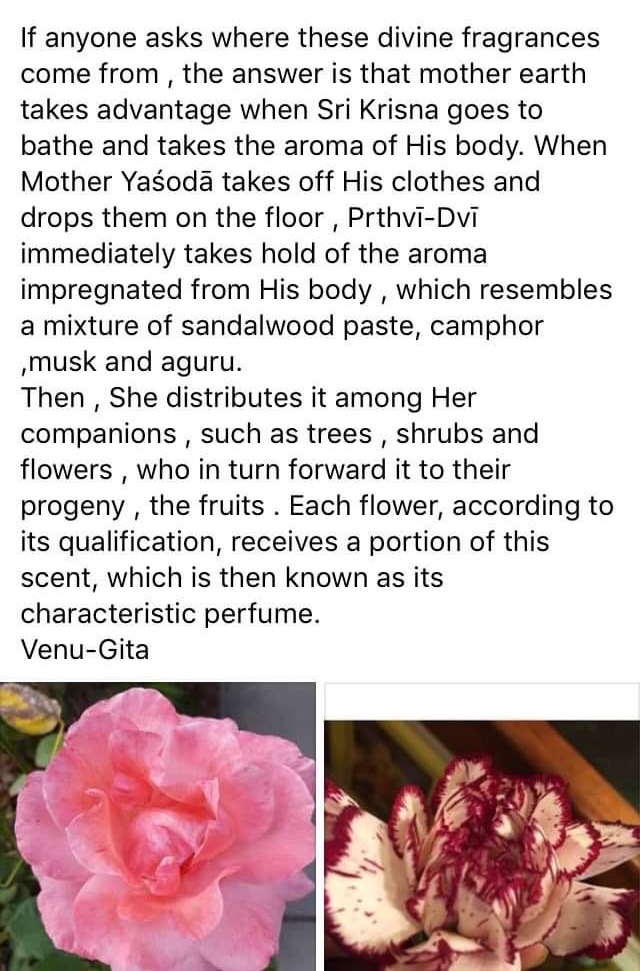
The origin of fragrance.
 Aroma Quest